
Protect and Survive
Protect and Survive - Last-minute prep for people who wait until the last minute to prepare.
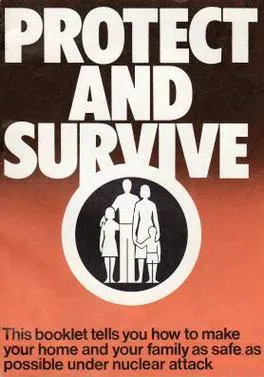
Protect and Survive - Last-minute prep for people who wait until the last minute to prepare.
Having seen some more recent reactions to “Protect and Survive,” the U.K. program for issuing pre-attack nuclear survival plans, I’ve decided to put in my two cents on it.
We Should Already Be Prepared
In 1945, the world entered the nuclear age. In 1952, the thermonuclear age superseded it. From the 1950s onward, information has been widely available on what preparations should be made in case of nuclear war, both publicly and (preferably) privately. In the United States, there was a public shelter program from 1960 until the mid-1970s, when it was discontinued for political reasons. It just didn’t fit in with the policy of “Mutually Assured Destruction” (M.A.D.). If we believe shelters work, so will the enemy.
But, what happened to private shelters? Hardly anyone cared to build them, so few were ever built. Either they believed it was hopeless, or they simply refused to think about the unthinkable actually happening.
False Hopelessness
Yes, the hydrogen bomb is vastly more powerful than the original atomic bomb. However, the destructiveness of the blast itself does not scale linearly. It’s true that if you’re within a few miles of one of these things when they go off, your troubles will be over rather quickly. A major city, industrial center, or a military facility would be unsafe places to be in a nuclear war.
But, ask yourself, “Do I live or work close enough to a target to be killed in the blast?” Chances are, you don’t.
The Real Threat
The real threat most people would face is radioactive fallout. Fallout occurs primarily when a nuclear weapon is detonated on, near, or under the ground. Debris from the blast is sucked into the fireball where it combines with fission products, then subsequently falls back to the ground. Areas where it falls can be subject to intense ionizing radiation. People exposed to the radiation can become sick, or even die, depending on their exposure.
The only defense is to put as much mass and distance between you and the fallout as you can, to minimize your radiation exposure. In time, the radiation levels will decay to safer levels. In other words, you need to spend that time in a “fallout shelter.”
However, a proper fallout shelter takes time and money to prepare, and you have to build and stock it well in advance of hostilities. The majority of people don’t do this, and never have.
What advice can a government give its people, when no one seems interested in preparing for the unthinkable?
Protect and Survive
Unlike the U.S., the U.K. government never had a public shelter program. However, they did make information publicly available. Just like in the U.S., hardly anyone paid attention to it.
The U.K. plan, in a period of high international tensions that threatened to turn into a nuclear war, was to send booklets to every home. The booklet, “Protect and Survive,” was to be accompanied by television broadcasts containing the same information. The information was very blunt, with instructions on everything from building expedient fallout shelters to how to dispose of the dead.
It was never meant to be disseminated, except in case of a probable attack. However, it was leaked to the public. The decision was made to go ahead and release it.
To say it caused a stir is an understatement.
Reactions to Protect and Survive range from horror at the casual matter-of-fact tone, to dark humor, to anger at the seemingly low effectiveness of the advice given by the program. But everyone seems to miss the point of the program. This is last-minute advice for those who waited until the last minute to prepare for an imminent catastrophe.
Is it good, effective advice? Of course not. It won’t help you if you’re in the blast radius. It’ll do little to help you if you’re in a heavy fallout zone. Otherwise, it’s better than no advice at all, which is essentially what’s given today. Building an expedient shelter within your home will likely only help those in lower fallout zones. For those people, the advice is helpful. Everyone else is doomed anyway, so at least the government provides guidance for how to deal with the dead.
What advice do you give at the last minute to people who refuse to prepare until the last minute?
Get Inside. Stay Inside. Stay Tuned.
“Get Inside. Stay Inside. Stay Tuned.” is the advice we’re given today. Easy to disseminate, easy to remember. But even less effective than Protect and Survive.
The average home provides very little protection from gamma radiation. It’s only marginally better than being outside. An expedient shelter at least provides some mass to attenuate the radiation. Books, heavy shelves, furniture, bags of earth, and containers of water can all help protect you. But only if you know to do it. That’s the message provided by Protect and Survive, and it’s completely absent from modern messaging.
It all boils down to a simple question. What advice do you give at the last minute to people who refuse to prepare until the last minute?
75 Years of Missed Opportunity
I don’t fault the U.K. government for their program. Nor do I fault the U.S. government for their laughable modern take. If I blame anyone, it’s lawmakers who missed the opportunity to codify protection into the system.
Since 1963, Switzerland has mandated shelter space for every single resident. Every building, every home built since 1963 must have a fallout shelter for the occupants. Every Western country could have done the same. Just add it to the building code. Not only for protection in a nuclear war, but for natural and other man-made disasters. How many lives could have been spared in the U.S. alone if every home had a place to go during a tornado or other severe weather event? Where I live didn’t exist 50-75 years ago, nor did most of the communities around me. They’re all relatively recently built. “Shelter in place” has more meaning when you actually have a shelter to seek. And it’s a whole lot easier to add one when the structure is being built, than it is to retrofit one after the fact.
Disasters happen all the time, and we’re still building and rebuilding, day after day, year after year. What’s a few more bucks for a PF100 hidey hole under the living room or back yard? We don’t like to think about it, so we don’t do anything about it.
Conclusion
You’re responsible for your own safety. Prepare for disaster ahead of time, or don’t. But don’t blame your government for offering last-minute advice. There’s only so much they can do when you refuse to prepare on your own.
Keep reading
Ten For Survival - What Do You Know?
Presented by NBC in 1958, "Ten For Survival" was a ten episode series about man and the atomic age. This rarely-seen episode "What Do You Know?", hosted by Chet Huntley, examined public perception of the survive-ability of nuclear war. Two "average citizens" give opinions concerning various Civil De
PDS Tornado Watch: The Particularly Dangerous Situation That Wasn't
On April 26, 2016 the Storm Prediction Center issued a PDS Tornado Watch that included a large portion of the North Texas area. This is a special kind of watch issued only in a Particularly Dangerous Situation. That is to say when computer models are predicting the possibility of extraordinarily sev
EMP 102: Details Missing From Discussions On EMP
EMP or Electromagnetic Pulse seems to be a pretty hot topic among disaster preparedness enthusiasts these days. For those who don't know, EMP happens when a powerful electrical disturbance in the upper atmosphere races towards ground (more precisely, THE ground), causing massive power surges in elec